
Candidate Physical Ability Test (CPAT)
Firefighting is one of the most physically demanding jobs there is. The Candidate Physical Ability Test (CPAT) shows that you can handle the physical tasks firefighters do on emergency scenes. The International Association of Fire Fighters (IAFF) and the International Association of Fire Chiefs (IAFC) developed the CPAT, and fire departments across the country use it as the standard physical test for new firefighters.
How the Test Works
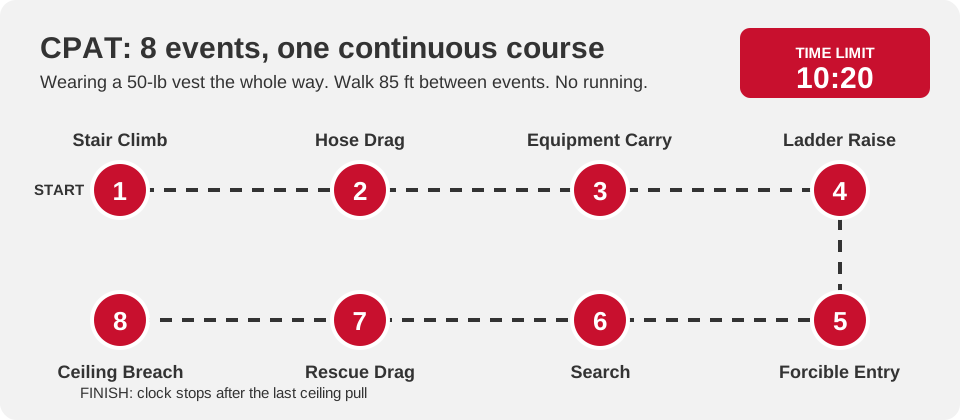
The CPAT is a pass/fail test made up of eight events. You complete them in a set order on one continuous course, and the clock never stops. You have 10 minutes and 20 seconds to finish all eight. You walk 85 feet between events. Running is not allowed anywhere on the course.
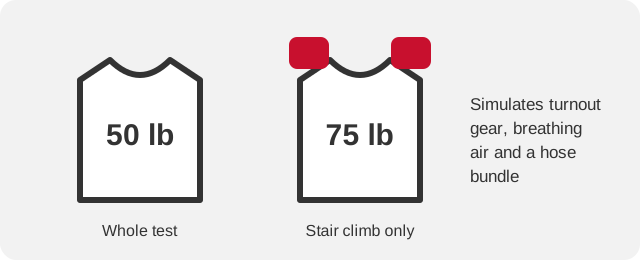
Throughout the test you wear a 50-pound vest. It simulates the weight of turnout gear and a breathing air pack. For the stair climb, 25 more pounds are added on your shoulders to simulate carrying a hose bundle up a stairwell, for 75 pounds in all.
You also wear a helmet, work gloves, long pants and closed-toe shoes. Watches and loose jewelry aren't allowed.
The Eight Events
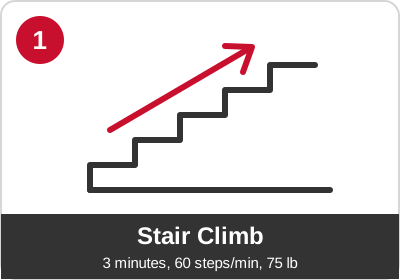
1. Stair Climb. You climb on a StepMill (a stair-climbing machine) for 3 minutes at 60 steps per minute, wearing 75 pounds. A 20-second warm-up comes first. This event shows you can climb stairs in full gear while carrying equipment to an upper floor.
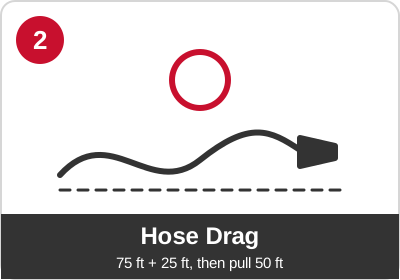
2. Hose Drag. You put a charged-line nozzle over your shoulder and drag a hoseline 75 feet to a marker, then turn and continue another 25 feet. Then you drop to one knee and pull the hose hand over hand until 50 feet of it has crossed the line. This shows you can advance a hoseline into position to attack a fire.
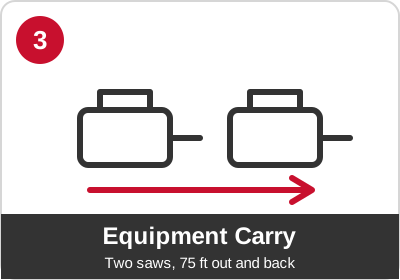
3. Equipment Carry. You take two power saws from a tool cabinet, carry them 75 feet out and back, and return them to the cabinet. This shows you can carry tools from the apparatus to the scene.
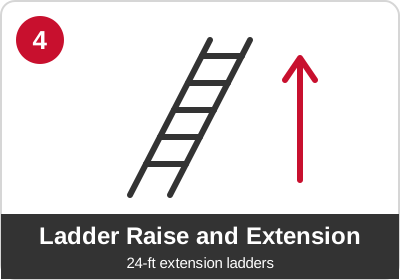
4. Ladder Raise and Extension. You raise a 24-foot ladder from the ground to a standing position, walking hand over hand up its rungs. Then you extend the fly section of a second ladder to full height and lower it under control. This shows the strength and control needed to place ladders at a building.
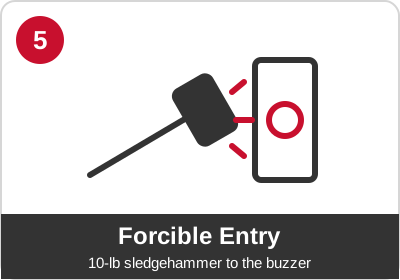
5. Forcible Entry. You strike a target with a 10-pound sledgehammer until a buzzer sounds. This shows you can force open a locked door or breach a wall.
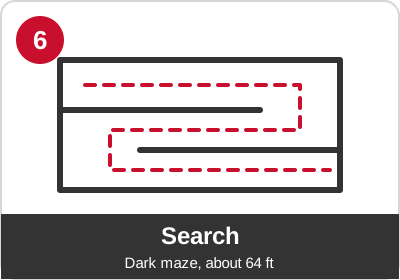
6. Search. You crawl through a dark, enclosed maze about 64 feet long, with turns, obstacles and tighter spaces. This shows you can search for victims when you can't see and the space is tight.
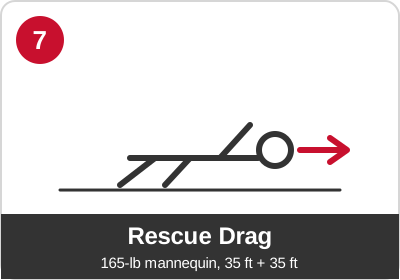
7. Rescue Drag. You drag a 165-pound mannequin 35 feet, turn around a marker and drag it another 35 feet to the finish line. This shows you can remove a victim or a downed firefighter from danger.
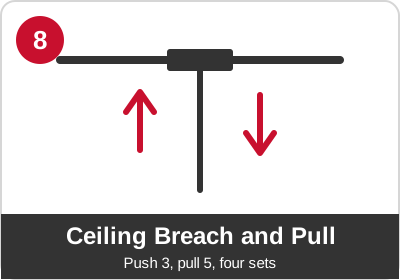
8. Ceiling Breach and Pull. Using a pike pole, you push a weighted ceiling panel up three times, then pull a weighted ceiling hook down five times. That is one set, and you complete four sets. The clock stops after your last pull. This shows you can open ceilings to check for hidden fire.
What Causes a Failing Score
- Not finishing all eight events within 10 minutes and 20 seconds
- Running between or during events
- Coming off the StepMill or falling during the stair climb
- Dropping or removing the vest
- Missing a required step in an event after warnings
Preparing for the CPAT
Most candidates who fail the CPAT run out of time, not strength. Train for endurance as well as strength, and practice working steadily for 10 minutes or more without a break.
- Build your endurance. Stair climbing, incline walking, rowing and interval training all help.
- Build strength. Focus on your legs, core, grip and shoulders. Pulling, carrying and pushing exercises match the test events best.
- Train with weight. Practice in a weighted vest or backpack, starting light and adding weight over several weeks.
- Go to an orientation and practice sessions. Testing sites usually offer them, and learning the course is one of the best ways to improve your time.
- Talk to your doctor before starting a new exercise program.
CPAT and Employment with Cahaba Valley Fire District
Candidates may obtain C.P.A.T. from any recognized testing site. Candidates are not required to have C.P.A.T. to submit an application, but those who have completed it at the time of application are given preference. If hired without completion of C.P.A.T., the candidate must pass C.P.A.T. prior to attending Recruit School.
Must have completed C.P.A.T. within the last 12 months.
Questions about the CPAT or the hiring process? Contact Capt. Russ Bradley- russ.bradley@cahabavalleyfire.org